

Intestinal Support Formulas – A Foundation for Healing
We know that the health of the body is dependent upon the health of the intestines. So an intestinal support formula is potentially one of the most important supplements you can add to assist in whole body health.
I suggest that you consider making your own formula of herbs and nutraceuticals to assist and support the healing of your gut. In this article I describe how I did this for myself.
I have been using a homemade “intestinal support” formula for several years now and feel confident that it has made a major difference in my intestinal and overall health as I progress with my own healing.
While there are many formulas on the market, and some of these are certainly worth using, it could become rather expensive to stay on these formulas long term.
In this article I will first give you my basic recipe, and then I’ll explain how I use the formula for myself.
Please keep in mind as you read the recipe that this is MY recipe tailored to my own needs. Everyone’s needs are individual. Most likely you will want to switch out some ingredients for other nutraceuticals, herbs or therapeutic foods.
Following the recipe, I’ll give the rationale for the ingredient choices I made for myself.
It is helpful to read other articles related to this topic to make the best choices for your own gut healing formula composition. In time, I will link additional articles from this one so that those are more easily found.
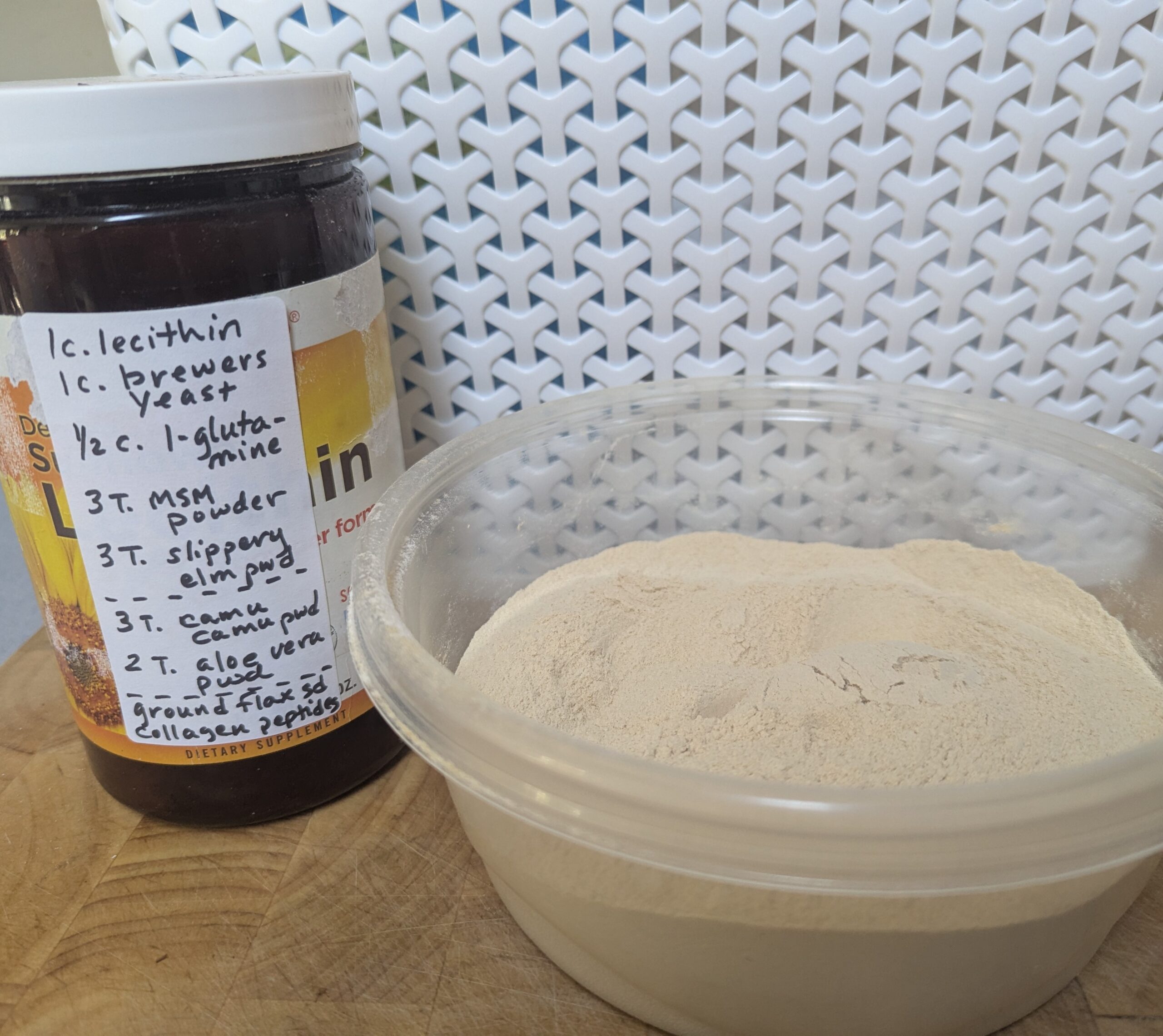
The Recipe
Below are the ingredients in three sections. The first is the “base” or the ingredients I consider essential in my own case. The second includes a couple of additional, optional items. The third includes the least essential possible additions. The instructions for making the formula are simple: combine the powders and mix thoroughly.
- 1 c. Lecithin
- 1 c. Brewer’s Yeast
- 1/2 c. l-glutamine
- 3 T. MSM powder (methonylsulfonomethane)
- 3 T. slippery elm powder
_________________________________________________
- 3 T. camu camu powder
- 2 T. aloe vera gel powder
__________________________________________________
- 2 T ground flax seed
- collagen peptides
How I Use This Mixture
Using the first five ingredients listed, what I do with this powder is:
- Place 3 T. of the powder into a jar
- To this, I add my probiotic (just the powder, no capsule), and mix thoroughly
- Then I add about 6 oz of water and shake well
- Finally, I add 1/2 t. to 1/2 T. humic/fulvic acid supplement (helps with gut integrity),
- Add some homemade coconut milk yogurt — I use about 3 T, and add
- 1.5 T pomegranate juice to improve the flavor (prune or other juices can be used; but each has special characteristics)
After a thorough mixing, my concoction is ready to drink. Often there are certain supplements I choose to take with this drink because I like to take them away from food. Typically I drink this soon after waking in the morning.
A Note About Probiotics
I like to take probiotics ensconsed in a healing formula with gut support because it gives the probiotics a matrix to live in and be supported by while being carried through the intestines. I also like to take them in the morning, usually just once a day. This is my own particular approach, and it is likely to be a good approach for others who are like me, especially if you tend to be quite sensitive to probiotics.
Among the rather large group of people with gut issues who benefit from probiotics are those with deeply entrenched gut issues. Some of these people will be very sensitive to probiotics; in some cases they may even feel they cannot take them at all. This was my problem for a decade or more; I knew probiotics were needed and tried over and over again to gradually raise the amount but the resulting increase in symptoms would stop me every time before I was able to reach a truly therapeutic level. Subsequently I have found a solution. There are fixes for this problem, but that concern will need to be more fully addressed in other articles.
The individuals most likely to have an extreme sensitivity to probiotics are those who tend toward autoimmune conditions (think; Hashimoto’s, psoriasis, MS, autism, certain neurological concerns, etc.). The “autoimmune type” tends to be different from the “very low immunity type” who is more likely to just keep getting infections over and over, or perhaps suffers from the more routine poor intestinal health issues that are common nowadays such as bloating, constipation, GERD or gastroesophageal reflux, indigestion and so forth.
People who don’t notice any special problem taking probiotics may want to take a larger probiotic dose once a day (similar to my protocol) but then also take additional smaller doses with each meal.
Ingredient Choices
I will briefly describe what I think is the role and usefulness of each of the first two groups of ingredients I listed above so you can determine whether you want to include any of these in your own formula.
Lecithin: I include lecithin because it is helpful for rebuilding cell membranes and it supports the liver. The body is made of cells and cells become damaged when there is disease or dysfunction or infection, thus, assisting the body with the building blocks of cell membranes can be very helpful. Anyone with neurological, brain or liver issues would potentially benefit from supplemental lecithin. Lecithin is good for anxiety and nerve issues as well. This is definitely NOT an ingredient you will find in most gut support powders that are commercially available, however, I find it indispensible for its myriad benefits.
Brewer’s Yeast: I include brewer’s yeast (similar but not exactly the same as nutritional yeast) as a form of totally natural food-based nutrition. It contains good amounts of b-vitamins, amino acids and minerals in their natural forms. Although I do not believe that food based sources of nutrients are essential for everyone (though, possibly they may be for some very sensitive people), I do think that when we can provide nutrients in this form, it is helpful to the body. I also like the taste and feel that the nutrients in the brewer’s yeast is helpful to the probiotics which I add to my formula. I will admit that there is only one brand I really like for brewer’s yeast, but probably there are other good ones I just have not found yet. Yeast based whole food nutrition may be problematic for some people due to sensitivities. Many people need a “yeast-free” diet due to chronic fungal infection creating a sensitized state of reactivity toward yeast derived foods. If you are one of these people, of course you should avoid brewers or nutritional yeast.
L-glutamine: This is of course a classic intestinal-support nutraceutical. I suspect most people are already familiar with it but in case you are not, this is the most abundant amino acid in the body. It is considered “conditionally essential” meaning that your body under normal conditions can synthesize the amount that it needs. However, during certain situations, the body’s ability to synthesize it is way outpaced by the rate at which it wants to use it to run the immune system and repair tissues, including, most particularly the gut, but also the muscles and brain and other tissues. One of the situations in which the body will have a high demand for l-glutamine is any kind of chronic infection or past or present tissue destruction. L-glutamine is often taken in high doses by athletes and it is also used to assist in healing all sorts of health conditions. Most people will benefit nicely from about 5 grams per day of supplemental l-glutamine to assist the gut, immune system, brain, etc. Some people can increase this amount a few times over to address more serious concerns. Despite the wonderful uses and excellent support provided by l-glutamine, there are a few people for whom more than tiny amounts of it, supplementally, is problematic. This is due to the conversion of l-glutamine to glutamate in the brain. In the brain, glutamate is an excitatory neurotransmitter; increasing l-glutamine can in certain people, lead to high glutamate and this can be really unpleasant. If you try the supplement and notice symptoms such as excitability or anxiety, you could be one of these individuals. A possible “work-around” might be to take a full complement of all or virtually all the amino acids in your gut healing drink, so that you are not selectively elevating just one amino acid.
MSM Powder: methonylsulfonomethane is a source of organic sulfur. It is naturally present in small quantities in foods such as meats, nuts, fish and tomatoes. Organic sulfur sources are important because, similar to l-glutamine, sulfur is needed in a wide array of bodily tissue maintenance and repair processes. For example, we need sulfur to maintain connective tissues such as collagen, joints and tendons. Many people take it for joint pain and inflammation as well as to assist in joint repair. Ample research has proven that is effective for these purposes. It is also needed to help form antioxidant defense compounds such as glutathione, and this in turn helps to support the immune system. It is needed to form keratin, a type of protein found in our skin, hair and nails. Organic sulfur compounds are particularly important for good liver function because sulfur is an integral component of many detoxificatory enzymes and proteins. The body literally uses up sulfur when it is disposing of toxins. For all these reasons, supplemental sulfur can assist us with our gut health and integrity along with whole body health of course. Supplemental MSM has the potential to assist the gut especially when there is small intestine bacterial overgrowth (SIBO). It does this by assisting with the repair process. It can help with the control of undesirable microbes such as pathogenic fungi and bacteria, and it can reduce bloating. Some people are sensitive to it, but usually starting low and gradually increasing the dose takes care of the problem. Normal doses are anywhere between 2500 mg and 4 grams per day. Years ago, listening to a podcast, I was told that MSM is needed as a supplement for most modern people due to the fact that our food crops are no longer grown properly utilizing animal manures as fertilizers. These manures are naturally high in sulfur compounds and so, without their addition to our agricultural soils, our foods have a much lower sulfur content than nature intended them to have. Over time, this deficit results in a lack of complete sufficiency for the body of this important nutrient.
Slippery Elm Powder: this herbal product is a real gem for gut health, in my opinion. In particular I find that, besides just being an overall soothing and mucilaginous food for the intestines, it is a cleanser that is very gentle. It helps to draw toxins out of the intestines so that they can be eliminated, all the while that it provides a soothing and moistening action in the intestines. It creates a thickening effect in the intestinal healing formula also, and this I believe is helpful for moving the probiotic through the intestinal tract while also supporting the beneficial bacteria as they travel. A helpful dose can be as small as 1/4 teaspoon. In some cases, especially when there is parasitic infection, it could be important to start as low as 1/8 or 1/4 teaspoon at time, as the drawing effect it has, pulling toxins into the intestinal lumen, can cause a sudden increase in toxins moving and this may result in some nausea or other discomfort.
Slippery elm was the last of the basic list of five ingredients I use consistently in my intestinal healing formula. I like to add some of the others in the final two lists below the main five, when I am able. Perhaps the most important addition to consider from those final two groups for most people would be the aloe vera gel powder, so I’d like to briefly describe it.
Aloe vera gel powder is now available. It used to be hard to find aloe vera except as a liquid. With its availability as a concentrated powder it is easier to add it into a healing formula. It is fine of course to use it separately as a liquid to obtain the benefits of this herb. Aloe is a time honored herbal remedy for intestinal soothing and healing (similar to slippery elm in some ways). Of course it can also be used to assist in the healing of skin wounds and burns by being applied topically. Aloe vera’s benefits have been ascribed to its high content of polysaccharides which are long chain sugars with special healing properties. These large molecules are able to assist in protecting us from pathogens such as viruses and at the same time they are known to help modulate the immune system to assist it to work more effectively. One key polysaccharide compound found in aloe vera gel or powder is called acemannan. There is an entire field of study that looks at the beneficial and healing effects of polysaccharides that are found in a variety of foods and herbs. It is believed by some researchers and clinicians that providing the “8 essential polysaccharides” to the human diet can dramatically improve the body’s ability to overcome, in particular, autoimmune problems. This is due to the fact that the body needs certain sugar sequences in order to perform proper cell-to-cell signalling — allowing the body to be properly regulated in its immune activity; ie knowing “self” from “non-self.”
We will leave our discussion here for the time being. For more information about possible components to incorporate into your gut healing formula please see other articles on this website on the topic of intestinal healing. If you create a formula that you think is particularly good, I would very much like to hear about it.