

Patterns and Ratios on a Hair Test Reveal the Stage of Stress of an Individual
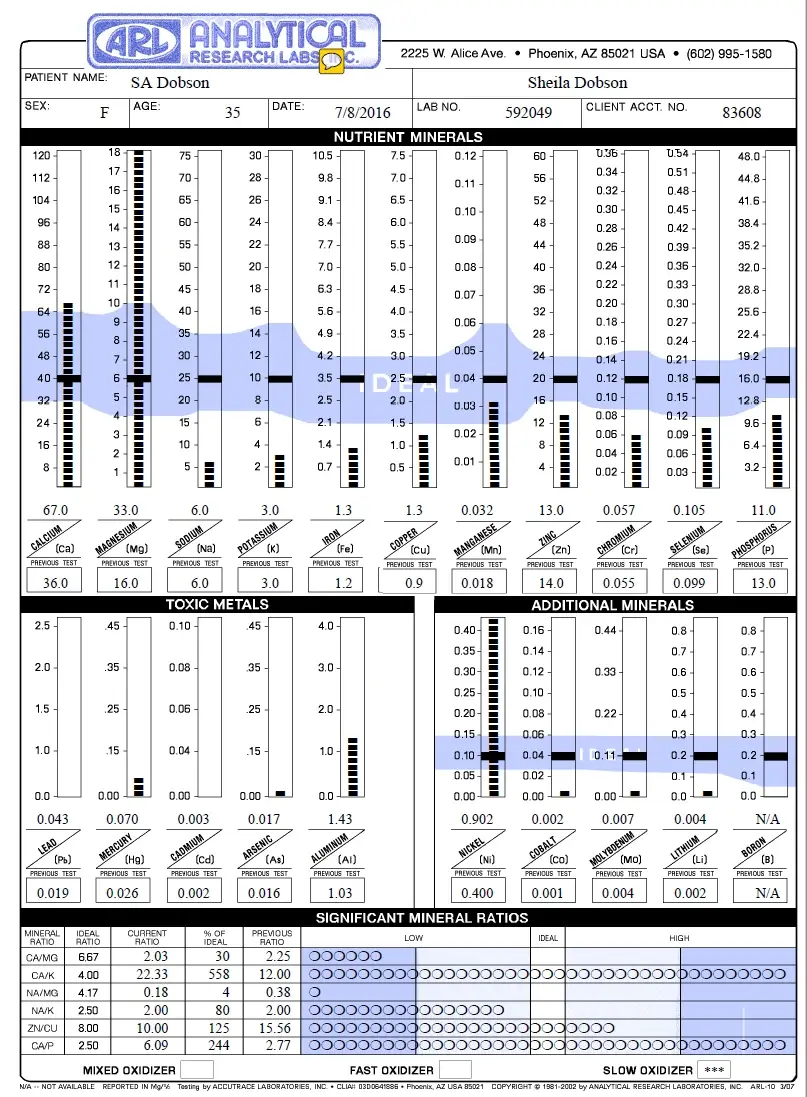
The hair tissue mineral analysis test shown above and below features a number of helpful examples that demonstrate how a hair test can reveal the stage of stress and the unique nutritional needs of an individual.
The First Four Minerals: Ca, Mg, Na, K – OR – Calcium, Magnesium, Sodium and Potassium
The first four minerals reveal the most important patterns. First of all, we can see whether a person is in “fast” or “slow” oxidation from the pattern of these minerals. To describe very simply how we do this, as a rule when calcium and magnesium are much higher above the middle black line indicating ideal levels, and sodium and potassium are below the line, the person is a “slow oxidizer.” This is what we are seeing on the test below.
When, conversely, the sodium and potassium levels are above the middle black line indicating ideal levels, and calcium and magnesium are below, we know the person is a “fast oxidizer.”
Naturally there are patterns that do not conform exactly to either of these simple designations, but are in fact a blend. We call this “mixed oxidation.” Usually mixed oxidation is present when a person is changing from one main type of oxidation (fast or slow) to the other, however, there are at times cases when a person may reside for quite a long time in a state of mixed oxidation.
The First Four Ratios Utilizing the First Four Minerals
If you look below the main graphs of the mineral levels on this chart, you will see “Significant Mineral Ratios.” These ratios have been discovered by numerous scientists and clinicians to be the most useful ratios to utilize when a practitioner wishes to pinpoint just exactly where a given individual lies on the spectrum of fast versus slow oxidation.
The first four ratios are: 1. Calcium:Magnesium 2. Calcium:Potassium 3. Sodium:Magnesium 4. Sodium:Potassium
- the Calcium : Magnesium Ratio — this is the carbohydrate ratio or the lifestyle ratio
- the Calcium : Potassium Ratio — this is the “thyroid” ratio and it helps us know if the thyroid is “running fast” or “slow”
- the Sodium : Magnesium Ratio — this is the “adrenal” ratio and it helps us to know if the adrenal glands are “running fast” or “slow”
- the Sodium : Potassium Ratio — this is the “vitality” ratio and it help us to know a more esoteric truth about the body which is hard to describe any other way than to use the word vitality, or perhaps “chi” or “life force” or “prana” – please see the article about Vitality on this website for more information.
Without going into details about how the ratios tell us what they do, let me just describe what this test is showing about the stage of stress of this individual.
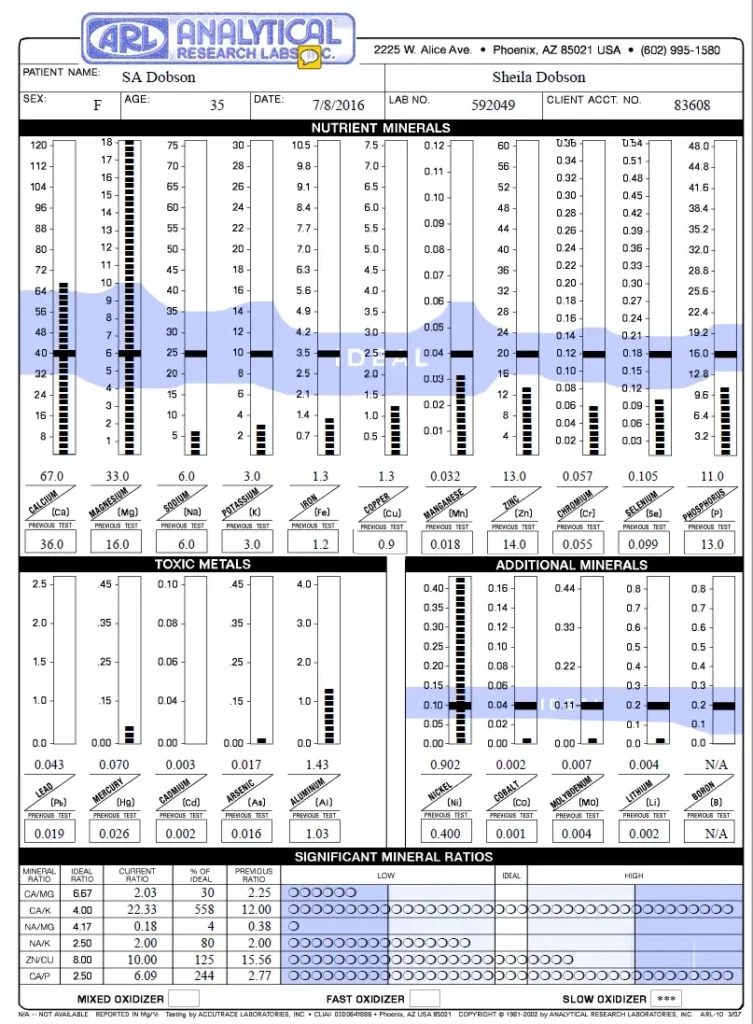
The calcium/magnesium ratio of 2.0 is telling us that the person has a distinct imbalance in the body’s ability to handle carbohydrates and sugars. A healthy ratio is between about 4.5 roughly, and 9.5.
The calcium/potassium ratio is telling us that that this person’s thyroid is running significantly slowly. A healthy or “perfect” ratio is about 4.0, therefore, this person’s thyroid is much slower than ideal since the ratio she presents with is about 5 times what the ideal value is.
The sodium/magnesium ratio is telling us that this person has adrenal exhaustion, given that the ratio showing is about 4% of the ideal, or about 20 times slower than the desirable level.
Finally, the sodium/potassium ratio showing, at 2.0 is telling us that this person’s vitality is significantly diminished. A healthy ratio is anywhere from 2.5 up to about 4.5. Any higher and it tends to indicate excess inflammation or a somewhat “overcharged” system, and much lower than 2.5 indicates a “lack of charge” so to speak. In such a state it is impossible for the body, brain and particularly the emotions and the immune system to function correctly.
Voila! We have now covered the very basic and rather elegantly simple science of reading a hair test at the introductory level. Rest assured there is a great deal more that can be known from these tests, however, in this introductory article, I only want to provide a basic road map so that those interested in how this science works can understand the most fundamental principles of it.
The Stage of Stress Shown In This Test
Now for how the test shows the stage of stress that this person is in.
First off, we see that the person is in “slow oxidation” and so we know that they are in some degree of burnout whether it be mild or more severe. So this indicates a resistance stage of stress.
Second we see that the adrenals are not mildly burned out but rather severely burned out, given that the sodium:magnesium ratio is only 0.18 whereas a normal or healthy ratio would be between about 2.5 and 5.0.
Not only is the person a slow oxidizer with significantly burned out adrenals, but the sodium:potassium ratio, the “vitality” ratio — which by the way is considered in many ways to actually be the most important ratio in the test….this ratio is significantly below the ideal of 2.5. With this particular ratio, any deviation below the standard of 2.5 indicates a degree of lack of vitality, whereas the other ratios tend to have a range both above and below that can be considered reasonably healthy.
When we consider these factors in conjunction, we can surmise that this is a person who, while in the resistance stage in some ways, is nonetheless beginning to fall into the exhaustion stage.
This is an important insight in order to be able to help this person recover, because it is telling us that this person’s body is fighting hard to deal with the stress of life.
I will not delve into the myriad patterns created in the first four minerals in any significant way in this article, but I will mention that this test is showing a pattern called a “double low ratio” pattern. This is created by the low calcium to magnesium ratio (2.0) and the low sodium to potassium ratio (also 2.0). In the system developed by my teacher and mentor of 13 years, Dr. Larry Wilson, MD, this pattern has certain specific traits and tendencies. You may read about the pattern here.